How to Choose a Software Development Partner for a Business Project
A practical framework for evaluating software development partners, reducing delivery risk, and choosing the right team for your business project.

Many companies choose a software development partner too late in the process and for the wrong reasons. They compare hourly rates, portfolios, or promises before they understand delivery risk, scope clarity, and how the team will actually support the business.
The result is often expensive: unclear requirements, slow execution, avoidable rework, weak architecture decisions, and software that becomes harder to maintain with every release.
This guide explains how to evaluate a software development partner from a practical business and technical perspective. It is written for founders, operations leaders, and teams planning a custom software, SaaS, internal platform, or integration-heavy project.
By the end, you will understand what to check before signing, which red flags matter most, and how to choose a partner that can support both delivery and long-term growth.
Where this article fits in the bigger picture
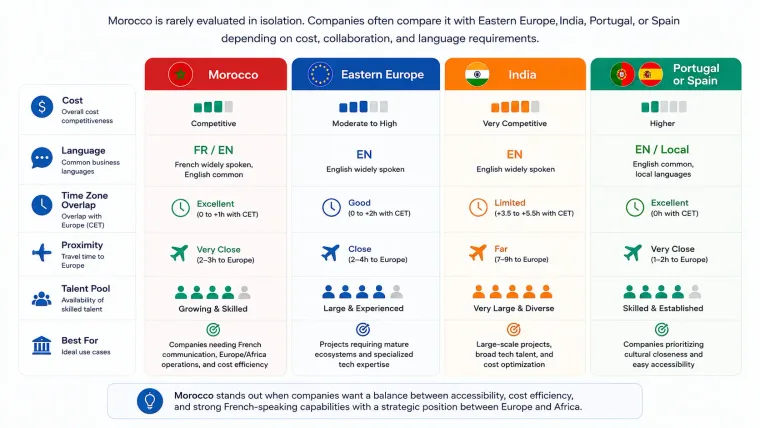
If your company is specifically evaluating an offshore destination, start with our guide to offshore software development in Morocco and use this article as the partner-evaluation layer that supports the final decision.
Why Choosing the Right Software Development Partner Matters
Most business software projects do not fail because of the programming language. They fail because the delivery structure is weak from the start.
When the wrong partner is involved, the pattern is predictable:
- scope stays vague
- the wrong features get prioritized
- architecture decisions are made too early or too late
- integrations are underestimated
- communication breaks down once pressure increases
- every change becomes slower and more expensive
The right partner reduces that risk. They help your team clarify what should be built, what should wait, what is likely to break, and what needs to be validated before development becomes costly.
If your project involves custom workflows, integrations, or long-term product evolution, it helps to evaluate the broader fit for software engineering services before you compare vendors only on price.
What a Software Development Partner Actually Does
A strong software development partner does more than supply developers. They turn a business problem into a delivery plan.
That usually means helping you:
- define goals and business constraints
- understand user roles and workflows
- identify the minimum useful version
- choose the right technical direction
- plan integrations and dependencies
- assess delivery risk before implementation starts
- structure launch and post-launch support
The best partners do not create more complexity to sound technical. They make the project clearer for both technical and non-technical stakeholders.
When a Partner Is Better Than Freelancers or Internal Hiring
Freelancers can work well for isolated tasks. Internal hiring can work well when your roadmap is clear and you already know what team structure you need. Many software projects sit in the middle, where neither option is enough on its own.
You are more likely to need a partner when:
- the project spans multiple roles such as product thinking, design, frontend, backend, QA, and DevOps
- the product depends on integrations, permissions, data flows, or operational workflows
- the scope is still evolving and needs structured discovery
- delivery speed matters more than building a team from scratch
- the business needs a roadmap, not only coding capacity
If your shortlist includes external teams, this guide on offshore vs nearshore software development can help you compare delivery models more clearly.
If Morocco is one of the destinations on that shortlist, the evaluation should go one step further. The right question is not only whether a team can build the product, but whether a Morocco-based partner can support the communication style, delivery structure, and business context your project needs. Our guide to offshore software development in Morocco breaks that decision down more directly.
The Cost of Choosing the Wrong Partner
The wrong software partner is expensive even when the initial quote looks attractive.
The hidden cost usually shows up later:
- requirements are misunderstood
- technical debt builds early
- no one documents major decisions
- testing is too shallow
- the business depends on one person for critical knowledge
- deployment and support become reactive instead of planned
Cheap development becomes expensive when the product has to be rebuilt, stabilized, or re-scoped after launch.
How to Evaluate a Software Development Partner
Start with four questions:
- Do they understand the business problem?
- Can they explain the delivery plan in simple terms?
- Do they identify risks before talking about execution speed?
- Can they show how technical choices support business outcomes?
Evaluate the Discovery Process
Discovery is where a serious project becomes clear. A partner should be comfortable saying that estimation depends on understanding scope, constraints, users, and risk.
A proper discovery process should define:
- project goals
- user roles
- core workflows
- integration needs
- technical constraints
- security requirements
- launch priorities
- assumptions that need validation
If a partner jumps directly to pricing without this context, that is a warning sign.
Evaluate Technical Depth Without Needing to Be Deeply Technical
You do not need to be an engineer to assess technical depth. Ask practical questions.
Good questions include:
- What would you build first and why?
- What part of this project is likely to become complex later?
- How would you structure permissions and access?
- How would you approach integrations with other systems?
- What would you simplify in version one?
- What delivery risks do you see right now?
A weak partner gives vague answers. A strong partner explains trade-offs.
One way to pressure-test that maturity is to compare their answers against models such as OWASP SAMM, which outlines how software organizations handle governance, design, verification, and operations in a more structured way.
Evaluate Testing, Security, and Maintenance
Business software should not be treated like a disposable build.
Frameworks such as the NIST Secure Software Development Framework are useful reference points when you want to see whether a partner treats secure development, testing, and release discipline as a real delivery capability rather than a vague promise.
At minimum, a partner should explain how they handle:
- authentication and permissions
- API and integration safety
- testing of core workflows and edge cases
- documentation and handover
- launch support and ongoing improvement
If they cannot explain how they reduce long-term maintenance risk, they are not thinking like a partner.
Questions to Ask Before Signing
Use these questions before you commit to a project.
If you want a stronger due-diligence lens for vendor evaluation, the CISA Secure by Demand guide is a practical external reference for the kinds of software supplier questions serious buyers should ask before signing.
Business and Product Questions
- What do you need to understand before estimating this project?
- How do you decide what should be built first?
- How do you prevent unnecessary features?
- How do you translate business workflows into software requirements?
Technical Questions
- What architecture would you recommend and why?
- What are the biggest technical risks in this project?
- How will the system handle roles and permissions?
- How will the system connect with other tools?
- How will the project be documented?
Delivery Questions
- What does your delivery process look like?
- How often will we review progress?
- How do you handle changes in scope?
- Who owns project communication?
- What happens after launch?
Risk Questions
- What could make this project fail?
- What assumptions should we validate first?
- What should not be built in version one?
- What would you simplify if the budget was limited?
The best partners are not annoyed by these questions. They usually welcome them.
Red Flags to Watch For
Be careful if a software development partner:
- promises an exact price before understanding the project
- cannot explain their process in clear business language
- avoids questions about testing, architecture, or maintenance
- says yes to every feature without discussing trade-offs
- has no clear communication rhythm or ownership structure
- pushes technology before understanding the business problem
- gives only generic portfolio answers instead of practical thinking
One red flag may not be a deal breaker. Several at once should make you pause.
A Simple Evaluation Checklist for Decision Makers
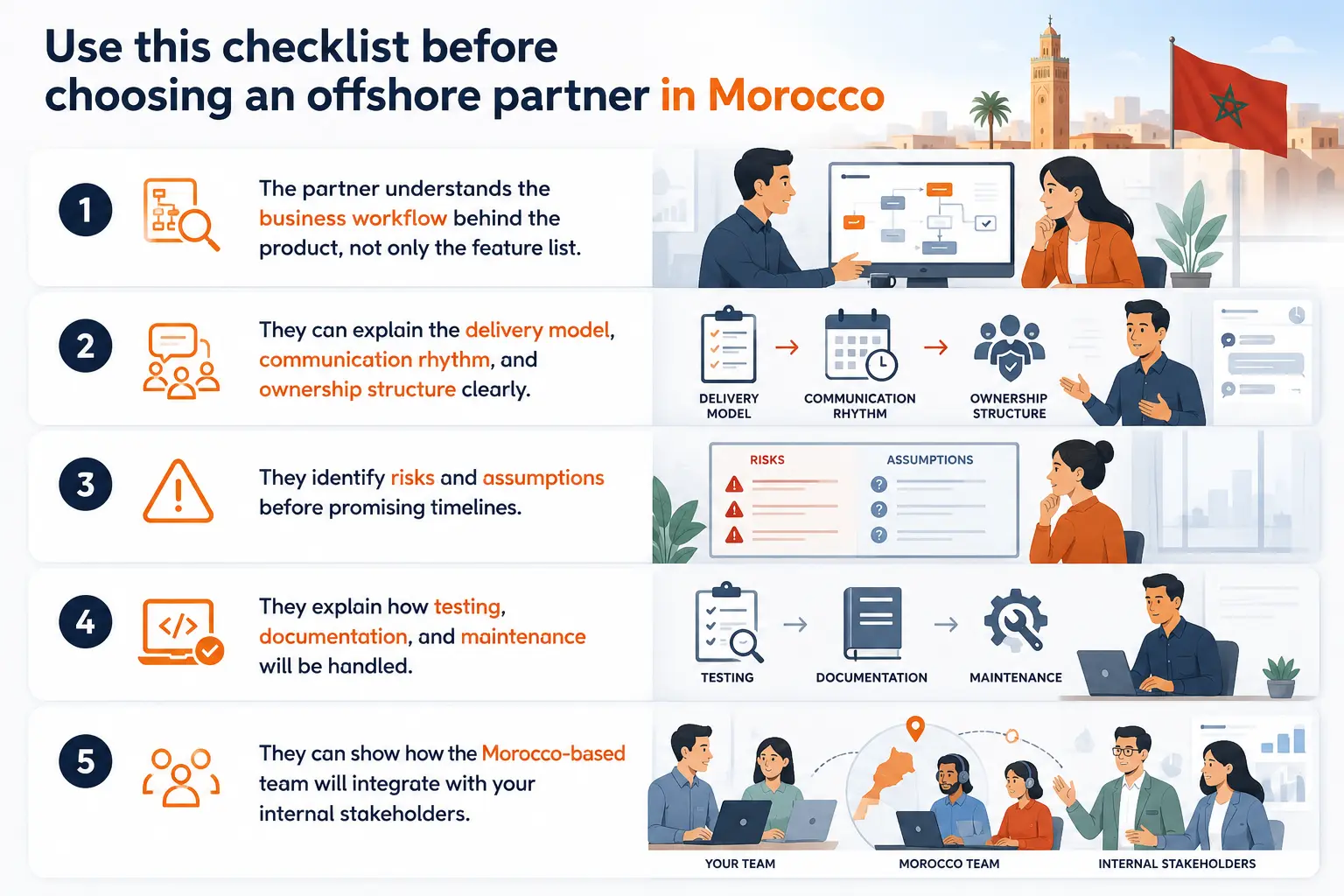
Freelancer vs Agency vs Dedicated Development Team
There is no universal best option. The right choice depends on the scope, delivery model, and level of ownership your project needs.
| Option | Best for | Watch out for |
|---|---|---|
| Freelancer | Small isolated tasks or short fixes | Limited capacity, process risk, and dependency on one person |
| Agency | Structured business projects with design, development, and delivery | Quality varies, so process and communication must be checked |
| Dedicated development team | Long-term product delivery, SaaS, and evolving platforms | Requires clear roadmap, priorities, and management rhythm |
How This Connects to Systechra Services
This topic connects directly to Systechra because many companies do not need code first. They need a practical roadmap first.
Systechra supports teams that need help with technical discovery, custom software development, web applications, SaaS products, API integrations, solution architecture, and dedicated development teams.
If your evaluation is part of a broader location strategy, our guide to offshore software development in Morocco explains how destination choice, delivery model, and partner quality fit together.
The goal is not to force a service pitch. The goal is to help you choose the safest next step for the project.
When the scope is still unclear, the best next step is often to book a technical discovery call before committing to a build plan.
Frequently Asked Questions
What is a software development partner?
A software development partner is a technical team that helps a business scope, design, build, integrate, and improve software around real business goals, workflows, and long-term needs.
How do I choose the right software development partner?
Choose a partner by evaluating their discovery process, technical depth, communication model, delivery structure, security practices, and ability to reduce business and delivery risk.
Should I hire freelancers, an agency, or a dedicated development team?
Freelancers fit isolated tasks, agencies fit structured business projects, and dedicated development teams fit long-term delivery where multiple roles and ongoing iteration are required.
What are the biggest red flags before signing a software project?
The biggest red flags are vague scope, no discovery process, unrealistic timelines, weak communication, unclear ownership, and poor answers on architecture, security, testing, and maintenance.
Do I need technical requirements before contacting a partner?
No. A strong partner should help you clarify goals, workflows, priorities, and risks before turning everything into a detailed delivery plan.
Keep reading