Morocco vs Eastern Europe for Software Outsourcing: Cost, Communication, and Delivery Trade-Offs
Compare Morocco and Eastern Europe for software outsourcing across cost, communication, technical depth, governance, and delivery fit so you can choose the right region for your software project.
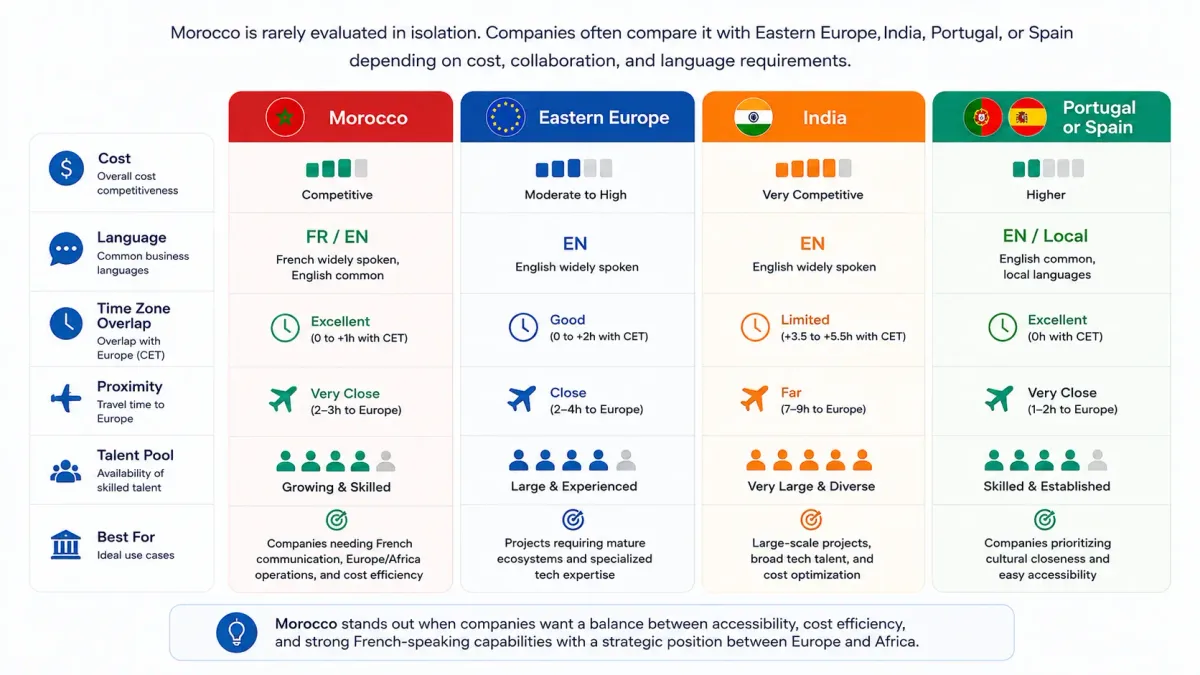
Companies comparing Morocco and Eastern Europe for software outsourcing are usually not trying to answer a geography question. They are trying to answer an operating question: which region gives us the best balance of cost, communication, delivery reliability, and technical fit for the kind of software project we actually need to run.
Both regions can be strong choices. Eastern Europe is often associated with a larger and more mature outsourcing ecosystem, while Morocco is increasingly attractive for companies that want strong overlap with Europe, multilingual collaboration, and a more flexible cost structure. The mistake is assuming that one region is always better in general.
The better choice depends on how your team works, how much real-time collaboration the project needs, how specialized the work is, and how much delivery structure your business can already provide internally.
This guide compares Morocco and Eastern Europe across cost, communication, engineering depth, governance, and delivery risk so you can choose the region that best fits your software outsourcing model.
If you are also evaluating Morocco as a destination more broadly, our guide to software development outsourcing in Morocco gives the wider market context. This article stays narrower: how Morocco compares with Eastern Europe when both are already on the shortlist.
Quick Answer: Morocco vs Eastern Europe
If you want the short version, Morocco is often a strong fit for companies that want a practical balance between cost efficiency and closer collaboration with Europe, especially when French or multilingual communication matters and the project needs a partner-led, accessible delivery model.
Eastern Europe is often a stronger fit when the work requires a broader specialist talent pool, a more established outsourcing ecosystem, or a scale profile that some buyers already know how to procure and manage.
Neither region is automatically better. Morocco may be the better choice for companies that value flexibility, accessibility, and nearshore-like collaboration without full Western European cost structures. Eastern Europe may be the better choice for companies that need deeper specialist coverage, a larger vendor landscape, or a region they already trust for complex outsourcing programs.
The right decision usually comes down to delivery model, governance maturity, communication needs, and the actual complexity of the software being built.
Morocco vs Eastern Europe at a Glance
| Factor | Morocco | Eastern Europe |
|---|---|---|
| Cost profile | Often more flexible than Western Europe and attractive for cost-conscious buyers who still want closer collaboration | Often competitive relative to Western Europe, but may be higher than Morocco depending on country and specialist demand |
| Timezone overlap with Europe | Strong overlap, often comfortable for daily collaboration | Strong overlap across most key markets |
| Language fit | Useful when French matters alongside English; multilingual business environments can be an advantage | Strong English capability in many vendor ecosystems; local language fit varies by country |
| Vendor ecosystem size | Growing and credible, but more selective and smaller overall | Larger, more mature, and broader across countries and specialties |
| Specialist depth | Strong for product engineering, web, integrations, cloud, and business software when validated vendor by vendor | Often stronger for niche or specialized engineering needs at scale |
| Travel accessibility | Practical for many European buyers, especially Western Europe | Also strong, often with easier intra-European business travel depending on destination |
| Best fit | Buyers who want cost efficiency, accessibility, multilingual collaboration, and a balanced delivery model | Buyers who want wider specialist choice, larger vendor markets, and established outsourcing comfort |
| Main watch-out | Do not assume every vendor has the same maturity or depth | Do not assume a strong regional reputation guarantees the right vendor fit or lower delivery risk |
Cost Comparison: Total Delivery Cost vs Team Rate
Cost is usually the first reason companies compare Morocco and Eastern Europe for software outsourcing, but it is rarely the best way to make the final decision on its own.
The most common mistake is comparing regions only by published hourly rates. That approach often ignores what the buyer is actually paying for: communication overhead, delivery governance, project management, QA, DevOps support, documentation quality, and the level of seniority required to keep the project moving without expensive rework.
In practice, total delivery cost matters more than headline team rate.
A region with a lower average rate can still produce a more expensive outcome if scope is poorly managed, communication slows decisions, or the team requires heavier client oversight to stay aligned. The opposite is also true. A region with a slightly higher price profile can still be the better financial choice if the delivery model is more stable, the technical fit is stronger, and the work reaches production with less friction.
Morocco is often attractive to buyers who want cost efficiency without moving to the most distant offshore model available. For some companies, that creates a useful middle ground: lower cost pressure than many onshore or Western European options, while still keeping collaboration close enough to support weekly decisions and active stakeholder involvement. If you want a broader Morocco-specific view of this cost-versus-delivery balance, our IT outsourcing in Morocco guide covers that question in more depth.
Eastern Europe is often viewed as competitive relative to Western Europe as well, but pricing can vary significantly by country, city, specialization, and vendor maturity. In some cases, Eastern Europe may justify a higher cost profile when the project depends on harder-to-find engineering depth, broader specialist coverage, or a procurement model the buyer already trusts.
The more useful cost questions are:
- how senior does the team need to be?
- how much live collaboration will the work require?
- how stable is the scope?
- how much internal product and technical leadership does the client already have?
- how much delivery governance is expected from the vendor?
Those questions usually tell you more about the real budget than a generic pricing table ever will.
If your main goal is the lowest visible rate, you may end up choosing the wrong region for the wrong reason. If your goal is the best balance between cost, coordination, and delivery confidence, the better choice will usually become clearer once you compare the full operating model rather than the rate card alone.
Communication, Timezone, and Collaboration Style
Communication quality is one of the biggest hidden variables in software outsourcing. It affects how fast decisions are made, how often requirements are misunderstood, how easy it is to resolve blockers, and how much management effort the client team must absorb during delivery.
That is why timezone overlap and collaboration style matter as much as technical capability.
Morocco is often attractive for European companies because it offers strong working-hour overlap and a collaboration rhythm that can feel close enough for regular check-ins, fast clarification, and practical weekly governance. It can be especially appealing when French matters in stakeholder communication or when multilingual collaboration is part of the working environment.
Eastern Europe also offers strong timezone compatibility for European buyers and is often already familiar to companies with established nearshore procurement patterns. In many cases, buyers see Eastern Europe as operationally straightforward because it combines real-time overlap with mature English-speaking vendor ecosystems across multiple countries.
The more important question, however, is not which region overlaps with your calendar. It is how your project needs to communicate.
Projects with stable scope, strong documentation, and clear internal ownership can work well with a more structured and partially asynchronous model. Projects that are still evolving often need heavier live collaboration, faster back-and-forth decisions, and a team that can stay close to business stakeholders throughout delivery.
Morocco may be the better fit when:
- your company wants close coordination with Europe without defaulting to a higher-cost local model
- French and English communication both matter
- the team values accessibility and a practical partner relationship
- the project needs frequent but manageable real-time collaboration
Eastern Europe may be the better fit when:
- your organization already works comfortably with vendors in that region
- the project depends on broader access to specialist profiles across multiple markets
- procurement or stakeholder confidence is already stronger there
- the team wants a mature outsourcing ecosystem with established delivery patterns
In both cases, weak communication habits at the vendor level will create delivery risk no matter how attractive the region looks on paper. A strong timezone match does not fix vague reporting, unclear ownership, or poor documentation. And a well-run vendor can often outperform a supposedly better-located alternative if the collaboration model is structured properly from the start.
That is why companies should evaluate not only where the team is based, but how the team works: how they report progress, how they escalate risk, how they document decisions, and how they handle ambiguity once real delivery pressure begins. If you are still deciding how much collaboration your outsourcing model should require, our offshore vs nearshore software development guide helps frame that choice more clearly.
Talent Depth and Technical Specialization
Talent depth matters most when the project depends on more than general software execution. If the work requires specialized backend architecture, enterprise integrations, data engineering, AI systems, regulated workflows, or niche product experience, the strength of the available talent pool becomes a serious decision factor.
Eastern Europe is often seen as the more mature and broader outsourcing ecosystem in this area. Many buyers associate the region with larger vendor markets, stronger specialization across multiple countries, and a longer track record serving international software companies at scale. That can make Eastern Europe attractive when the project needs a wider range of senior specialists or when procurement teams want more vendor options in the shortlist.
Morocco can still be a strong choice, but the evaluation usually needs to be more selective. The right Moroccan partner may be an excellent fit for product engineering, custom business software, internal tools, cloud delivery, integrations, multilingual collaboration, and long-term managed development. The key difference is that buyers should validate actual vendor capability carefully rather than assuming broad specialist depth across the entire market.
This is why region-level comparisons can become misleading if they replace vendor-level due diligence. A country may have a strong reputation, but the actual success of the engagement still depends on the specific team, its delivery habits, and how well its experience matches the project.
If your software project needs a highly specialized stack or a broader bench of niche profiles, Eastern Europe may have an advantage. If your software project needs strong collaboration, practical accessibility, and a capable product-delivery partner with the right validated experience, Morocco may be the better fit.
The useful question is not which region has the “best developers” in the abstract. The useful question is which region is more likely to give you the right delivery team for the real work in front of you.
Delivery Models: Which Region Fits Which Setup?
The region matters, but the delivery model often matters more.
Many outsourcing problems are blamed on geography when the real issue is that the team structure did not match the way the project needed to run. Before choosing Morocco or Eastern Europe, companies should first clarify whether they need extra execution capacity, a stable long-term team, a fixed-scope project partner, or a more managed delivery model.
Staff Augmentation
Staff augmentation works best when your company already has strong internal product leadership, engineering standards, and day-to-day ownership.
Eastern Europe is often attractive here because of the broader specialist market and the ease of sourcing individual profiles across multiple countries. Morocco can also work well, especially when the company wants timezone overlap with Europe and values accessibility and multilingual communication. In both cases, this model fails if the client expects external developers to replace missing internal direction.
Dedicated Development Team
A dedicated team is usually the better fit for longer roadmaps, evolving products, and software that needs continuity across engineering, QA, architecture, and delivery coordination.
Morocco can be especially attractive when the buyer wants a more partner-led relationship with close collaboration and practical access to the team. Eastern Europe may be stronger when the buyer needs larger scaling potential, broader specialist choice, or already has confidence in vendors from that region.
Fixed-Scope Project
A fixed-scope project works best when requirements are genuinely stable, dependencies are understood, and the client can make decisions early.
Either region can support this model, but the real success factor is discovery quality. If the scope is weak, both low-cost and high-cost vendors can create expensive change friction later.
Managed Delivery Partner
This model fits companies that want more than developers. They want a partner who can help with delivery governance, quality control, technical planning, communication, and execution.
This is often where Morocco can stand out for the right buyer, especially when accessibility, communication rhythm, and a practical working relationship matter as much as cost. Eastern Europe can also be strong here, especially through mature vendors with established outsourcing processes. The deciding factor is usually not the region, but the maturity of the partner’s delivery system.
The safest approach is to choose the model first, then evaluate which region is more likely to support that model well for your business. If vendor selection is the harder decision than geography, our guide on how to choose a software development partner gives a more direct due-diligence framework.
Governance, Reliability, and Delivery Risk
The most expensive outsourcing mistakes rarely begin with code. They begin with weak governance.
A company can choose a technically capable team in either Morocco or Eastern Europe and still get poor results if decision-making is slow, reporting is vague, scope ownership is unclear, or delivery risks are not surfaced early. Geography does not solve those problems. Strong governance does.
Reliable software outsourcing usually depends on a few consistent factors:
- clear ownership of scope and priorities
- visible progress and reporting
- documented technical decisions
- testing and release discipline
- practical escalation paths when blockers appear
- clarity around infrastructure, access, and support responsibilities
This is where buyers often underestimate the difference between a vendor that writes code and a vendor that can actually support delivery.
Eastern Europe may feel safer to some procurement teams because the region already has a long-standing outsourcing reputation and a larger visible vendor landscape. Morocco may feel more selective, but the right partner can still outperform a better-known region if the governance model is stronger and the collaboration fit is better.
The key lesson is simple: country reputation should never replace operational due diligence. A strong outsourcing decision depends on how the team works under pressure, not how the region is marketed.
When Morocco Is the Better Choice
Morocco is often the better choice when your company wants a balanced outsourcing model rather than an extreme one.
It may be the stronger fit when:
- you want cost efficiency without moving to the most distant offshore option available
- your stakeholders need strong overlap with European working hours
- French matters alongside English in communication
- you want a partner that feels accessible and collaborative
- your project needs a stable delivery relationship rather than anonymous execution capacity
- the software work includes product development, internal tools, integrations, business systems, or long-term roadmap support
Morocco can be especially attractive for companies that do not want outsourcing to feel operationally distant. In those cases, the combination of proximity, communication fit, and partner accessibility can be more valuable than simply choosing the largest outsourcing market.
When Eastern Europe Is the Better Choice
Eastern Europe is often the better choice when your company needs a broader specialist ecosystem or already has strong confidence in that region as a sourcing model.
It may be the stronger fit when:
- the project requires more niche technical specialization at scale
- you want a larger pool of vendors and profiles to compare
- your organization already has experience working with Eastern European partners
- procurement, legal, or stakeholder comfort is stronger there
- the roadmap may require a wider bench of technical roles across multiple disciplines
- the buying team wants a region with a longer-established outsourcing reputation
Eastern Europe can also be the safer choice when the project depends on larger team scaling or when the organization already knows how to manage vendor relationships in that environment.
Questions to Ask Before Choosing a Region
Before choosing Morocco or Eastern Europe, make sure your team can answer these questions clearly:
- What are we outsourcing: execution capacity, delivery ownership, or both?
- How much real-time collaboration will the project need each week?
- Is French, English, or multilingual stakeholder communication important?
- How specialized is the technical work?
- Do we need a larger vendor market or a more selective partner relationship?
- How much governance can our internal team provide?
- Are we comparing total delivery fit or just rate cards?
- What would make this engagement fail even if the initial pricing looked attractive?
If those answers are still unclear, the next step is usually not vendor selection. It is better project definition.
Final Recommendation
Morocco and Eastern Europe can both be strong software outsourcing choices. The better option depends less on reputation and more on fit.
Choose Morocco when you want a balanced model built around cost efficiency, European collaboration, multilingual communication, and a partner relationship that stays accessible throughout delivery.
Choose Eastern Europe when you need a larger outsourcing ecosystem, broader specialist depth, or a region your organization already trusts for more mature sourcing at scale.
The wrong way to choose is by asking which region is better in general. The right way is to ask which region is more likely to support your delivery model, communication needs, governance structure, and technical requirements with the least operational friction.
Planning Your Outsourcing Model?
If you are comparing Morocco and Eastern Europe for an upcoming software project, you can review our software engineering services or contact Systechra to discuss the delivery model, team structure, and region fit that best matches your roadmap.
Frequently Asked Questions
Is Morocco cheaper than Eastern Europe for software outsourcing?
Sometimes, but not always. Final cost depends on the country, vendor model, seniority mix, project complexity, and how much QA, DevOps, project management, and delivery governance are included.
Which region is better for European companies?
Both can work well for European companies. Morocco can be attractive for accessibility, multilingual collaboration, and cost balance, while Eastern Europe can be attractive for broader vendor choice and specialist depth.
Is Eastern Europe better for complex software projects?
Not automatically. Eastern Europe may offer a broader specialist ecosystem, but complex software projects still succeed or fail based on vendor capability, governance, and technical fit rather than region alone.
When is Morocco the better outsourcing choice?
Morocco is often the better choice when buyers want strong European timezone overlap, French and English communication, practical partner accessibility, and a balanced delivery model that does not feel too distant operationally.
What matters more: country or vendor quality?
Vendor quality matters more. Region can influence cost, talent access, and collaboration style, but the success of the engagement usually depends on the actual team, delivery process, communication habits, and governance maturity.
Which region is better for dedicated development teams?
Both can support dedicated teams well. Morocco may be attractive for close collaboration and partner-led continuity, while Eastern Europe may be attractive when the buyer wants broader scaling options or a larger specialist market.
Keep reading