Offshore vs Nearshore Software Development: Which Model Fits Your Company?
Compare offshore and nearshore software development across cost, communication, delivery risk, timezone alignment, and control so you can choose the right model for your project.
Companies often compare offshore and nearshore software development as if the decision were only about geography or hourly rates. In reality, the better choice depends on how your project needs to be managed, how much collaboration it requires, and how much delivery risk your team can absorb.
A lower-cost team is not automatically the better option if communication breaks down, scope keeps changing, or technical ownership is unclear. A closer team is not automatically better either if the project is well-scoped and can run efficiently with strong async execution.
This guide explains the real differences between offshore and nearshore software development, including cost, collaboration, governance, quality control, and delivery fit.
By the end, you will have a practical way to decide which model better matches your project, your team, and your business constraints.
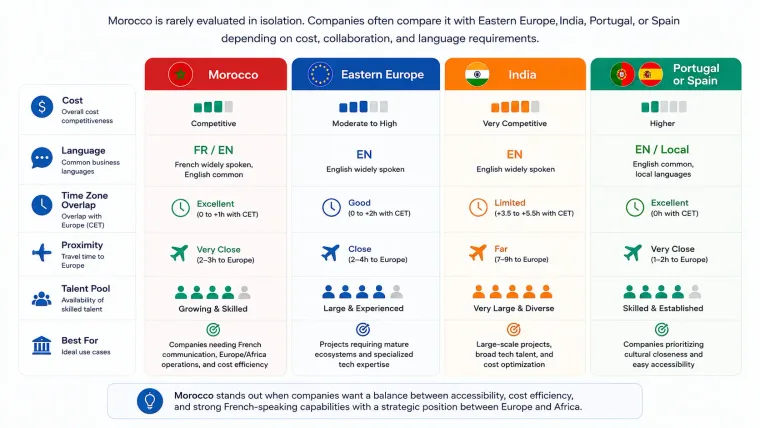
If you are comparing delivery models while also evaluating a specific destination, our guide to offshore software development in Morocco shows how this decision fits into a broader Morocco-based outsourcing strategy.
That matters because Morocco often sits in a practical middle ground for companies that want offshore cost efficiency without jumping immediately to the furthest possible delivery geography. The better choice still depends on project structure, but Morocco is often evaluated precisely because of that balance.
What Offshore and Nearshore Software Development Actually Mean
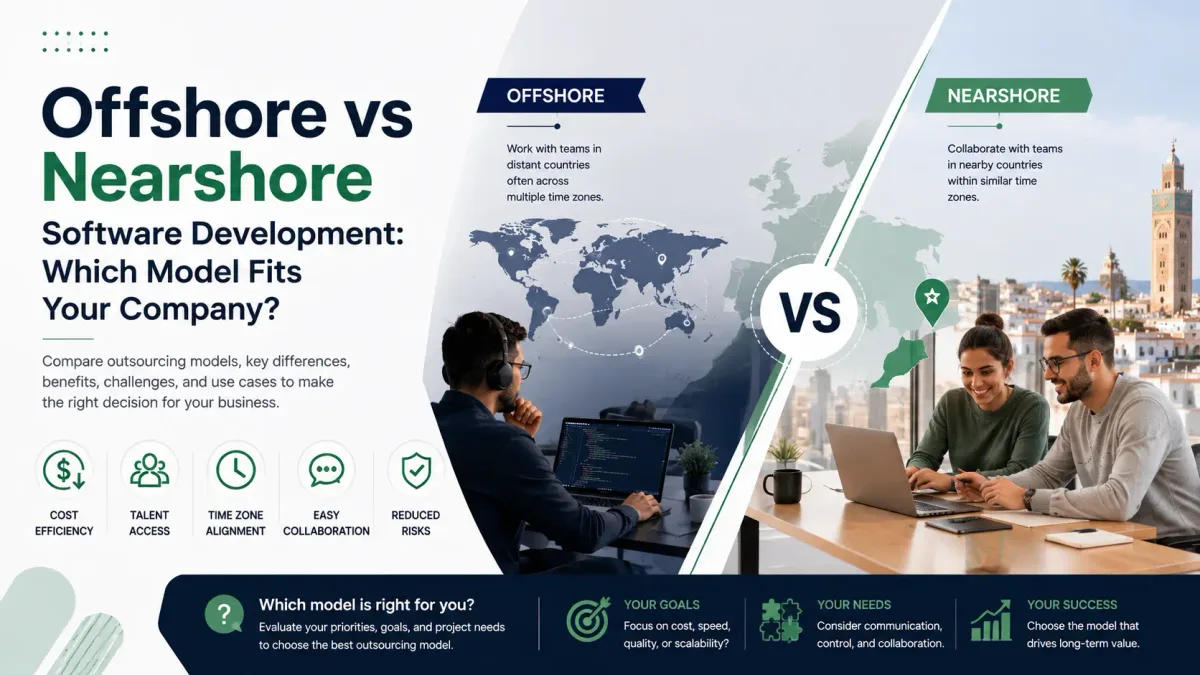
Offshore development usually means working with a team in a more distant geography with a wider timezone gap. Nearshore development usually means working with a team in a closer region where working hours, communication style, or travel access are easier to align.
The labels matter less than the operating model behind them.
Before comparing regions, it helps to understand what a strong software development partner should actually help your business achieve.
Why Companies Compare Offshore and Nearshore Models
Companies usually compare these models for three reasons:
- they need to control delivery cost
- they need access to technical talent faster than local hiring allows
- they need a delivery setup that fits their communication style and internal capacity
The mistake is treating geography as the only variable. In practice, success depends more on scope quality, governance, documentation, and communication discipline than on location alone.
Offshore vs Nearshore: Key Differences at a Glance
| Factor | Offshore development | Nearshore development |
|---|---|---|
| Cost structure | Usually lower hourly or monthly cost | Usually higher than offshore, but often lower than local hiring |
| Timezone overlap | Lower overlap, more async coordination needed | Greater overlap, easier real-time collaboration |
| Communication rhythm | Works best with strong documentation and structured handoffs | Works well when teams need frequent calls and fast clarification |
| Management overhead | Can increase if scope, ownership, or communication is unclear | Often easier to manage when stakeholders want close involvement |
| Access to talent | Broad talent pool with flexible scaling potential | Strong option when proximity and coordination matter more |
| Best-fit projects | Well-scoped builds, mature processes, async-friendly delivery | Collaboration-heavy projects, evolving scope, workshop-driven delivery |
| Main delivery risk | Misalignment caused by weak governance or unclear ownership | Higher cost without meaningful delivery improvement |
Cost, Timezone, and Collaboration Trade-Offs
Cost should be evaluated as total delivery cost, not only the team rate.
That broader view matters because supplier evaluation frameworks such as CISA’s Secure by Demand guidance make it clear that governance, update practices, and operational transparency can affect business risk as much as headline price.
That includes:
- how much management overhead your team can absorb
- how often decisions require live discussion
- how likely the project is to change during delivery
- how much documentation and handoff discipline already exists
Offshore teams often work best when the scope is well-defined and your internal team can support structured async collaboration. Nearshore teams often work best when the project needs heavier real-time coordination, recurring workshops, or faster clarification loops.
Offshore tends to fit best when
- ✓ The scope is relatively clear and the project can run with structured async coordination.
- ✓ Budget efficiency matters and the team can work well with stronger documentation and handoffs.
- ✓ The company already has a practical decision-making rhythm and technical ownership in place.
Nearshore tends to fit better when
- ! The project needs frequent live workshops and fast day-to-day clarification.
- ! Stakeholders expect heavy overlap across the week and more synchronous collaboration.
- ! The scope is still evolving quickly and decisions depend on tighter real-time feedback loops.
Quality Control, Governance, and Delivery Risk
The biggest difference between a good and bad outsourcing decision is usually governance.
Well-established practices such as the NIST Secure Software Development Framework reinforce the same point: structured engineering and release discipline reduce risk regardless of whether the team is offshore or nearshore.
Strong delivery governance includes:
- clear scope ownership
- practical documentation
- visible task tracking
- clear decision points
- technical leadership
- testing and release discipline
Weak governance makes any model feel risky. Strong governance makes both models more workable.
For companies managing external delivery partners, NIST guidance on supply chain risk management is also a useful reminder that visibility, ownership, and third-party controls matter more than geography labels alone.
Teams evaluating outsourcing models often start by clarifying their broader needs around software engineering services, delivery ownership, and long-term maintainability.
When Offshore Development Is the Better Fit
Offshore development is often the better fit when:
- the project is clearly scoped
- your team is comfortable with async execution
- documentation quality is strong
- budget efficiency matters
- technical leadership and approval paths are already defined
This model can work especially well for product teams that already know how they want to collaborate and can avoid constant live clarification.
When Nearshore Development Is the Better Fit
Nearshore development is often the better fit when:
- the project requires frequent working sessions
- stakeholders want more overlap during the week
- scope is still evolving rapidly
- product decisions depend on frequent feedback loops
- the team prefers more synchronous communication
Nearshore can reduce friction when the project is still being shaped in parallel with execution.
How to Choose the Right Model for Your Company
The better model depends on how the work needs to happen.
If the project is clearly scoped, documentation is strong, and your team can work effectively with structured async collaboration, offshore development may offer the best balance of cost and execution.
If the project needs frequent workshops, rapid back-and-forth decisions, heavier stakeholder involvement, or faster clarification during delivery, nearshore development may create less friction.
The wrong choice usually happens when companies optimize for geography before they define communication needs, scope quality, and delivery ownership.

How This Connects to Systechra Services
Systechra helps companies evaluate delivery models before they commit to a build team. That includes clarifying scope, reducing delivery risk, and deciding whether the project needs deeper discovery, a structured partner, or a dedicated development model.
If Morocco is one of the locations you are considering, our guide to offshore software development in Morocco can help you connect this comparison to a more concrete destination-level decision.
The goal is not to force one outsourcing model. The goal is to choose the one that fits your project, team, and operating reality.
If you want to compare offshore and nearshore options against your actual project constraints, you can talk through your project with Systechra before committing to a delivery model.
Frequently Asked Questions
What is the difference between offshore and nearshore software development?
Offshore development usually means working with a team in a more distant region with a larger timezone gap, while nearshore development usually means a closer region with more overlapping working hours and easier real-time collaboration.
Is offshore software development more risky than nearshore?
Not automatically. Offshore projects become risky when scope, communication, governance, and quality controls are weak. With clear delivery structure and strong technical leadership, offshore teams can perform very well.
When is nearshore development the better option?
Nearshore is often the better fit when your project needs frequent live collaboration, faster clarification loops, and closer coordination between stakeholders and the delivery team.
How do I choose between offshore and nearshore development?
Choose based on project complexity, budget sensitivity, timezone needs, internal management capacity, and how much real-time collaboration your team requires during delivery.
Can offshore development still work for complex business software?
Yes, especially when the project has clear scope, solid documentation, strong architecture ownership, and a delivery model designed for asynchronous execution.
Keep reading
Related articles
- Offshore Software Development in Morocco: A Practical Guide for Companies Choosing the Right Partner
Offshore Development
- Morocco vs Eastern Europe for Software Outsourcing: Cost, Communication, and Delivery Trade-Offs
Outsourcing
- IT Outsourcing in Morocco: Costs, Talent and Vendor Checklist (2026)
Outsourcing