IT Outsourcing in Morocco: Costs, Developers & Complete Guide 2026
Explore IT outsourcing in Morocco: developer costs, hiring models, nearshore advantages, risks, and how to choose the right outsourcing partner.
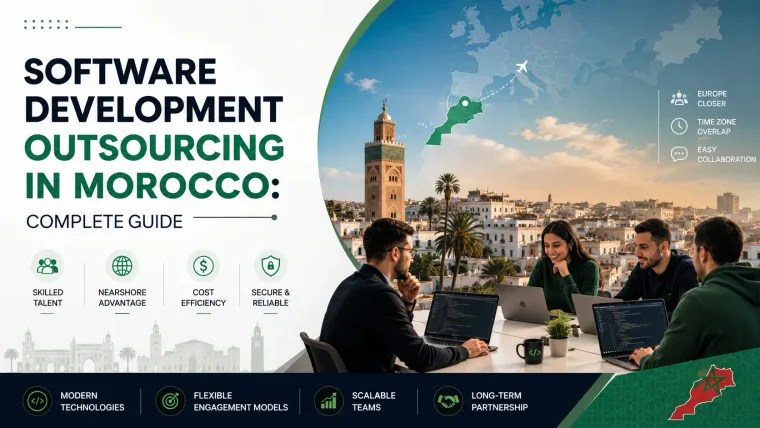
IT outsourcing in Morocco means working with a software team or outsourcing partner based in Morocco to build, extend, maintain, or support digital products and business systems. For many European and international companies, Morocco is attractive because it combines timezone overlap, multilingual collaboration, and a growing digital ecosystem with a cost structure that is often more flexible than onshore hiring. This guide explains what companies should actually evaluate before outsourcing to Morocco: costs, skills, engagement models, benefits, risks, data protection, and how to choose a partner that can reduce delivery risk instead of adding it.
Quick answer
Morocco is worth evaluating when your company wants a practical balance between cost efficiency and closer collaboration. It is rarely the right choice because of price alone. It becomes attractive when timezone alignment, French or English communication, structured delivery, and partner quality matter as much as hourly cost.
Why Morocco Is Becoming an IT Outsourcing Hub
Morocco is not a new digital market, but it is becoming more visible in outsourcing conversations because it sits at the intersection of several practical buying criteria: proximity to Europe, a multilingual business environment, government-backed digital modernization, and a technology sector that is still growing.
According to the World Bank, Morocco is strategically located at the crossroads of Europe, Africa, and the Middle East, and has used that position to strengthen its role in trade, investment, and services. That geography matters for outsourcing buyers because it affects working-hour overlap, travel practicality, and how easily an external team can stay connected to European stakeholders.
The U.S. International Trade Administration’s 2025 Morocco Digital Economy guide also shows that Morocco is still actively expanding its digital ecosystem. The report highlights the Digital Morocco 2030 strategy, which emphasizes e-government services, foreign investment, startup ecosystem development, cloud, AI, connectivity, and talent development.
Practical framework
Why buyers keep Morocco on the shortlist
Closer coordination with Europe
Morocco is often evaluated because it offers strong overlap with European working hours and easier travel access than more distant outsourcing markets.
Multilingual business environments
French remains important in many business contexts, while English is increasingly relevant in software delivery. That mix can be useful for cross-border projects.
Government-backed digital growth
Public digital strategy, cloud and AI priorities, and support for startup growth all point to a market that is still expanding rather than standing still.
A middle-ground outsourcing profile
Morocco is often compared not only on cost, but on its balance between affordability, communication, and delivery accessibility.
That does not mean every Moroccan vendor is equally mature. It means Morocco deserves serious evaluation when your company wants a nearshore or nearshore-like collaboration pattern without defaulting to Western European cost structures.
How Much Does IT Outsourcing Cost in Morocco?
This is one of the most searched questions, but it is also one of the easiest places to publish weak SEO content. Public rate comparisons vary widely by source quality, contract structure, and what is actually included in the price. Published numbers often mix freelance rates, vendor billing rates, gross salaries, and recruiter estimates as if they were interchangeable.
For that reason, the table below is presented as a procurement template rather than a claim of verified live market pricing. Where current public evidence is not strong enough, the values are clearly marked for human verification.
| Role | Morocco | Western Europe | Eastern Europe | India / comparable offshore market |
|---|---|---|---|---|
| Junior Developer | Needs human verification | Needs human verification | Needs human verification | Needs human verification |
| Mid-Level Developer | Needs human verification | Needs human verification | Needs human verification | Needs human verification |
| Senior Developer | Needs human verification | Needs human verification | Needs human verification | Needs human verification |
| Tech Lead / Architect | Needs human verification | Needs human verification | Needs human verification | Needs human verification |
Why this table is intentionally conservative
- Public sources often publish salary figures rather than vendor billing rates.
- Vendor rates can include QA, project management, DevOps, tooling, and support, while salary data does not.
- Contract structure changes the number significantly: staff augmentation pricing and fixed-project pricing are not directly comparable.
- Senior AI, cloud, DevOps, and architecture work is often priced differently from general web development.
What actually changes the price
The strongest pricing discussions usually start with cost drivers, not headline rates:
- Seniority mix: a team with stronger architecture or DevOps leadership costs more, but may reduce rework.
- Technology choices: React, Java, Python, mobile, data, AI, and cloud work do not always sit in the same pricing band.
- Project complexity: integrations, enterprise workflows, and security-heavy builds raise delivery cost faster than brochure websites or small CRUD tools.
- Language expectations: high client-facing fluency in English and French can influence staffing and rates.
- Contract duration: a longer engagement can create more pricing flexibility than a short or urgent engagement.
- Hiring model: staff augmentation, dedicated team, managed delivery, and fixed-price work are priced differently.
- Ops requirements: CI/CD, observability, cloud governance, infrastructure, and incident readiness affect the real cost.
- Data and AI scope: machine learning, data engineering, and generative AI work often need more specialized profiles.
If you need a more practical location-level outsourcing view before vendor conversations start, our guide to software development outsourcing in Morocco covers the delivery-model side in more depth.
Need an estimate for your development team?
If you already know the roles, seniority, and delivery model you need, the fastest way to compare Morocco against other regions is to request like-for-like vendor proposals instead of relying on generic blog pricing tables.
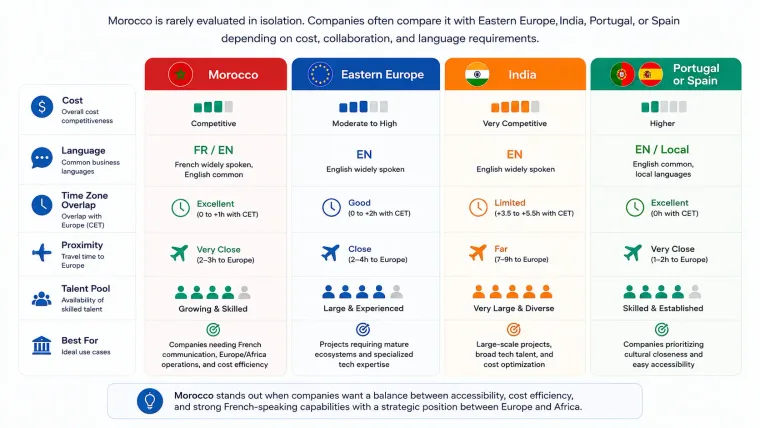
Morocco vs Other Software Outsourcing Destinations
Morocco is rarely assessed in isolation. Companies usually compare it against Eastern Europe, India, Portugal, or another market that already sits on the shortlist.
The most useful comparison is not “which country is best?” but “which location best matches the way our project needs to be delivered?”
Morocco vs Eastern Europe
Eastern Europe is often attractive because of its mature engineering ecosystems, strong proximity to European buyers, and deep experience serving international software clients. For some organizations, it may still be the better option when they need a very broad pool of specialized software talent across many countries.
Morocco can become more compelling when:
- French-language collaboration is useful alongside English
- the buyer wants timezone compatibility with Europe but is open to a non-EU location
- travel access into North Africa is acceptable or beneficial
- the goal is to balance affordability with a closer communication rhythm
Eastern Europe may still be stronger when:
- the project needs a larger immediately available talent market
- the company already has a procurement model optimized for Eastern European vendors
- the work depends on niche specialization that has already been validated there
Morocco vs India
India remains one of the most established global outsourcing markets, especially for companies that need scale, process maturity at large enterprise vendors, or extremely broad technology hiring capacity.
Morocco may be the better fit when:
- the project depends on more live collaboration with European stakeholders
- travel time and timezone overlap matter to product, engineering, or executive teams
- the buyer wants a smaller-partner model rather than a very large offshore delivery machine
India may be stronger when:
- extremely large team scaling matters immediately
- the buying organization already knows how to manage far-shore delivery at scale
- cost is the dominant decision criterion and the business accepts the trade-offs that may come with wider coordination gaps
Morocco vs Portugal / Western Europe
Portugal and other Western European markets often feel operationally safer because they sit inside more familiar legal, commercial, and cultural environments for EU buyers.
Morocco may be stronger when:
- the company wants more pricing flexibility than Western Europe usually provides
- the engagement needs a strong nearshore feel without full Western European cost structures
- French-speaking collaboration is important
Portugal or Western Europe may be stronger when:
- the buyer requires an EU-based vendor model for internal policy reasons
- legal, regulatory, or stakeholder comfort with EU-only delivery outweighs cost concerns
- the project needs frequent in-person workshops with minimal travel friction inside Europe
A practical decision rule
Use country comparison to evaluate trade-offs, not to pick a winner by slogan.
Morocco tends to fit best when
- ✓ You want better overlap with Europe than a far-shore model usually gives you.
- ✓ French or English communication is part of the collaboration requirement.
- ✓ You care about partner accessibility, governance, and cost together rather than cost alone.
- ✓ Your project needs a balanced nearshore-like operating model, not a massive delivery factory.
Another destination may fit better when
- ! You need very large-scale hiring immediately and already know how to govern global delivery at that scale.
- ! The work requires a niche specialist pool that has been validated more deeply in another region.
- ! Your procurement or compliance model strongly favors EU-only or jurisdiction-specific vendors.
- ! The buying decision is driven almost entirely by lowest possible cost rather than delivery fit.
For a model-first view of location trade-offs, read our offshore vs nearshore software development guide.
What Technologies Do Moroccan Developers Work With?
It is better to treat technology capability as a vendor-level question than as a generic market claim. Still, companies evaluating Morocco usually expect teams to work across mainstream software product, platform, cloud, and integration stacks.
At Systechra, the public service and technology pages already reflect work across mainstream software engineering categories, including React, Node.js, Java, Python, Laravel, AWS, Docker, and broader product engineering delivery.
Frontend
- React
- Next.js
- Angular
- Vue
- TypeScript
Backend
- Java / Spring Boot
- Node.js
- Python
- PHP / Laravel
- .NET where the vendor team supports it directly
Mobile
- Flutter
- React Native
- Swift
- Kotlin
Cloud & DevOps
- AWS
- Azure
- Google Cloud
- Docker
- Kubernetes
- CI/CD workflows
Data & AI
- Python for data and machine learning workflows
- data engineering pipelines
- BI and reporting layers
- generative AI or automation work where the team has direct project experience
Use the technologies page and the software engineering services overview to verify how a specific partner positions its capabilities in public, then pressure-test that against actual case studies and interviews.
IT Outsourcing Models Available in Morocco
The right model matters as much as the country. A strong location fit can still fail if the engagement model does not match the roadmap.
Staff Augmentation
Staff augmentation means external developers join your existing delivery system.
Best for: internal product teams that already have strong leadership, architecture ownership, and clear engineering processes.
Advantages:
- fast access to execution capacity
- flexible scaling by role or skill gap
- easier to plug into an existing team model
Limitations:
- weak internal leadership can turn added developers into added noise
- your team still owns day-to-day direction and delivery rhythm
Dedicated Development Team
A dedicated team is a longer-term group that works as an extension of your roadmap, often across multiple roles.
Best for: ongoing products, evolving platforms, and companies that need continuity across development, QA, architecture, and delivery coordination.
Advantages:
- stronger continuity than ad hoc augmentation
- easier knowledge retention over time
- better fit for long-term roadmap execution
Limitations:
- requires a clear decision-making rhythm
- usually needs stronger governance than a one-off project
Fixed-Price Software Development
Fixed-price delivery works best when the scope is genuinely stable.
Best for: well-defined initiatives, bounded MVPs, or clearly specified business workflows.
Advantages:
- budget visibility
- clearer milestone structure
- useful when procurement needs bounded scope
Limitations:
- weak discovery creates scope friction fast
- change requests can make the model inefficient
Managed Development / Project Outsourcing
Managed outsourcing means the partner owns more of the delivery process, not just individual contributors.
Best for: companies that want a delivery partner to help with coordination, quality control, technical planning, and execution.
Advantages:
- less internal delivery overhead
- better fit when the business also needs structure and reporting
- useful when roadmap clarity is still improving
Limitations:
- success depends heavily on vendor governance quality
- weaker providers can hide delivery problems behind process language
| Model | Best for | Flexibility | Client involvement | Typical duration |
|---|---|---|---|---|
| Staff augmentation | Existing engineering teams that need more capacity | High | High | Short to medium term |
| Dedicated development team | Long-term roadmap execution | High | Medium to high | Medium to long term |
| Fixed-price software development | Stable, bounded scope | Low | Medium at milestone points | Short to medium term |
| Managed development / project outsourcing | Companies that need partner-led delivery structure | Medium | Medium | Medium to long term |
If your main question is how to choose the right model after Morocco is already shortlisted, our guide to how to hire software developers in Morocco goes deeper into model selection and screening.
Benefits of Outsourcing Software Development to Morocco
Morocco can be attractive because it combines several advantages that buyers often want in the same package:
- cost efficiency compared with many onshore hiring models
- nearshore or nearshore-like collaboration for Europe
- practical timezone overlap for real-time work
- multilingual communication environments
- access to engineers across product, backend, integrations, and platform work
- scalability beyond a single freelancer or ad hoc contractor setup
- easier travel access than more distant offshore locations for many European buyers
- a collaboration model that can support agile working rhythms when the partner is mature enough
The important word is can. These benefits are not guaranteed by geography alone. They only become real if the vendor has the technical and operational maturity to support them.
Risks and Challenges of IT Outsourcing to Morocco
Credible outsourcing content should address the downside clearly.
The biggest risks are usually not “Morocco risks” in isolation. They are outsourcing risks that need to be managed in the Moroccan context just as they would in any other market.
Common risks
- Vendor quality differences: provider maturity can vary sharply.
- Communication and process maturity: not every team has the same delivery structure or stakeholder discipline.
- Security gaps: access control, environment management, and release discipline are not equal across vendors.
- IP ambiguity: weak contracts create ownership and reuse problems later.
- Developer retention: continuity matters if the work is long-term.
- Documentation gaps: undocumented decisions create handover and maintenance risk.
- Governance weakness: unclear priorities and unclear decision ownership slow delivery.
- Hidden costs: weak discovery can turn a cheap quote into a costly rebuild.
How to reduce those risks
- run technical and process due diligence, not only pricing comparison
- start with a pilot or a scoped first sprint
- check how architecture and delivery decisions are documented
- clarify repository ownership, access, environments, and support boundaries
- review case studies that match your project type, not just generic references
- use measurable KPIs for speed, quality, communication, and issue management
If partner evaluation is your biggest concern, start with how to choose a software development partner before comparing quotes alone.
Data Protection, GDPR and Intellectual Property
This section is informational only, not legal advice.
Morocco has its own personal data protection framework, and the CNDP publishes the regulatory framework around Law 09-08 and related procedures. That matters for local compliance context, but European companies still need to evaluate their own GDPR obligations when outsourcing work involving personal data.
For EU-facing projects, the operational basics usually include:
- clear NDA terms before sensitive project material is shared
- explicit IP ownership clauses covering code, documentation, and deliverables
- a data-processing agreement where the relationship requires one
- role clarity between controller and processor under GDPR Article 28 where applicable
- security of processing obligations under GDPR Article 32
- attention to third-country transfer requirements under GDPR Chapter V when personal data is accessed from outside the EU
- strict repository, cloud, credentials, and environment access controls
- documented rules on subcontracting and who can access what
From a delivery perspective, the goal is simple: security and data governance should be part of project setup, not a paperwork exercise left for the end.
The NIST Secure Software Development Framework is also useful here because it gives buyers a practical way to ask how a vendor handles secure development, vulnerability reduction, and release discipline.
How to Choose an IT Outsourcing Company in Morocco
Use this checklist before you sign.
Decision Review
Morocco outsourcing vendor checklist
- 01
Define the technical scope, business constraints, and success metrics before comparing vendors.
- 02
Review relevant case studies, not just generic portfolio pages.
- 03
Check the actual experience level of the developers who may join the project.
- 04
Conduct technical interviews or scenario-based delivery discussions.
- 05
Evaluate English and French communication where it matters to your stakeholders.
- 06
Review security practices, access control, and release discipline.
- 07
Clarify intellectual property ownership, confidentiality, and subcontracting rules.
- 08
Understand how pricing changes across models, roles, and support scope.
- 09
Start with a pilot, discovery phase, or tightly scoped first sprint.
- 10
Define measurable KPIs for delivery speed, quality, visibility, and issue handling.
A partner that cannot explain these topics clearly before the project starts is unlikely to manage them well once delivery pressure increases.
If your buying team wants to compare structured service options first, the custom software development service page is a useful internal reference point.
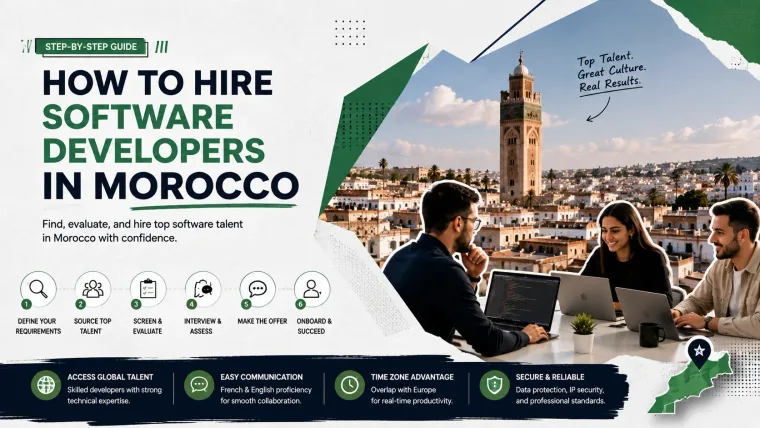
How to Start Outsourcing Software Development to Morocco
Step 1 – Define requirements
Clarify the business problem, key workflows, priorities, risks, and what success actually means.
Step 2 – Choose the outsourcing model
Decide whether the project fits staff augmentation, a dedicated team, fixed-price delivery, or a managed partner model.
Step 3 – Shortlist vendors
Filter for relevant case studies, communication quality, stack fit, and visible delivery maturity.
Step 4 – Review developer profiles
Look past resumes and check whether the team has the right seniority, architecture depth, and delivery habits.
Step 5 – Conduct interviews
Use practical questions about trade-offs, testing, risk, documentation, and integration complexity.
Step 6 – Run a pilot project or sprint
Validate communication, output quality, and delivery rhythm before scaling the team.
Step 7 – Measure results
Track velocity, quality, issue handling, responsiveness, and clarity of reporting.
Step 8 – Scale the team
Only scale once the model works operationally, not just commercially.
Who Should Consider Outsourcing to Morocco?
Morocco is often a strong fit for:
- European startups that need engineering capacity without a fully local cost structure
- SaaS companies with ongoing product roadmaps
- SMEs that need a reliable partner rather than one-off freelancers
- scale-ups that need to extend delivery without overloading internal hiring
- enterprises looking for a managed partner or specific delivery pod
- agencies that need overflow or delivery support with multilingual coordination
- businesses that benefit from French-speaking collaboration alongside English
- teams that want nearshore-style working rhythms from a non-EU market
When Morocco May NOT Be the Right Choice
No destination is right for every project.
Morocco may be a weaker fit when:
- you need very large hiring scale immediately and already know another region can supply it faster
- the project depends on a highly specialized niche capability that has not been validated in the shortlisted Moroccan vendors
- cost alone is the decision criterion and the business is willing to accept the trade-offs of a much more distant model
- internal policy or client requirements strongly favor another jurisdiction
- the company expects the external team to replace missing product ownership entirely
That does not make Morocco a weak market. It means the location still needs to match the actual operating model of the project.
Final Decision Framework
Before you outsource to Morocco, make sure you can answer these questions clearly:
- What are we outsourcing: execution capacity, delivery ownership, or both?
- How much real-time collaboration does the project need each week?
- Do we need French, English, or both in stakeholder communication?
- Are we comparing like-for-like vendor proposals or just generic pricing claims?
- What would make this engagement fail operationally even if the rate looks attractive?
If those answers are still unclear, the best next step is usually not procurement. It is discovery.
IT Outsourcing Morocco FAQ
The FAQ block at the end of this article answers the most common questions companies ask when they evaluate Morocco for software outsourcing. Every question in that block is also visible on this page, which is why FAQ structured data is appropriate here.
Build Your Development Team in Morocco
If you are comparing Morocco against another destination, or you need help choosing between staff augmentation, a dedicated team, or a more managed delivery model, contact Systechra for a practical discussion about scope, team structure, and delivery fit.
You can also review our offshore software development services, software development services, and case studies before starting vendor conversations.
Sources & References
- World Bank: Morocco overview
- U.S. International Trade Administration: Morocco digital economy
- U.S. International Trade Administration: Morocco market overview
- CNDP: Law 09-08 and Moroccan personal data protection framework
- CNDP: foreign transfer notification information
- ANRT: Moroccan telecommunications regulator and sector observatories
- NIST SP 800-218: Secure Software Development Framework (SSDF)
- EUR-Lex: Regulation (EU) 2016/679 (GDPR)
Claims requiring human verification before publishing as hard numbers
- Role-by-role hourly rate comparisons for Morocco, Western Europe, Eastern Europe, and India
- Any vendor-specific billing benchmarks
- Any claim about exact market-wide developer counts or graduation numbers unless a directly citable official source is added
Frequently Asked Questions
Is Morocco a good country for IT outsourcing?
Morocco can be a strong IT outsourcing destination for companies that want timezone overlap with Europe, multilingual collaboration, and a delivery model that balances cost efficiency with easier coordination.
How much do software developers cost in Morocco?
Developer cost in Morocco varies by seniority, stack, delivery model, project complexity, and language expectations. Public rate data should be validated with live vendor proposals before procurement decisions are made.
Is Morocco cheaper than Eastern Europe for software development?
Sometimes, but not always. Final cost depends on team composition, vendor model, governance, and the type of work involved. Morocco is often evaluated for its balance between cost and collaboration, not for being universally the lowest-cost market.
Can Moroccan developers work with European companies?
Yes. Morocco is commonly evaluated by European companies because of timezone compatibility, travel accessibility, and multilingual collaboration across French and English business environments.
What programming languages and frameworks are common in Morocco?
Teams in Morocco commonly work across mainstream web, backend, cloud, mobile, data, and AI stacks, but capability should be validated partner by partner rather than assumed from the market alone.
Is Morocco considered nearshore for Europe?
For many European companies, yes. Morocco is often treated as a nearshore or nearshore-like option because it offers close timezone alignment and relatively easy travel access compared with more distant offshore markets.
Can I hire a dedicated development team in Morocco?
Yes. Dedicated teams, staff augmentation, fixed-price projects, and managed delivery are all common outsourcing models for companies working with Moroccan software partners.
What is the difference between staff augmentation and a dedicated team?
Staff augmentation adds developers into your existing delivery system, while a dedicated team gives you a more stable multi-role unit that works with your roadmap over a longer period.
How do I evaluate a Moroccan software development company?
Review delivery governance, relevant case studies, communication quality, technical depth, security practices, documentation standards, and how the team handles ambiguity before signing.
Can Moroccan developers work in English and French?
Many companies evaluate Morocco precisely because French is common in business environments and English is increasingly important in software delivery, but language capability should still be verified with the specific team you plan to hire.
How should intellectual property be handled when outsourcing to Morocco?
IP ownership, repository access, confidentiality, subcontracting, data-processing responsibilities, and handover obligations should be clarified contractually before development starts.
How quickly can an outsourced development team be started?
The real timeline depends on hiring model, team size, interview depth, and project readiness. A better goal is not the fastest start, but the fastest credible start with the right delivery structure.
Keep reading