How to Hire Software Developers in Morocco
A practical guide to hiring software developers in Morocco, including hiring models, screening methods, communication fit, and the mistakes that create avoidable delivery risk.

Hiring software developers in Morocco is usually not just a sourcing decision. It is a delivery decision.
Most companies are trying to answer a more practical question: what kind of team structure will give us the right mix of technical quality, communication, and execution reliability without creating management overhead we cannot absorb?
That is why the best hiring process starts before interviews. You need to know whether you are looking for individual contributors, a managed external team, or a long-term delivery partner.
If your first question is broader than hiring alone, our guide to software development outsourcing in Morocco gives the market-level view. This article stays narrower: how to hire well once Morocco is already on your shortlist.
Why Companies Hire Developers in Morocco
Companies usually hire developers in Morocco when they want a practical balance rather than an extreme one.
Common reasons include:
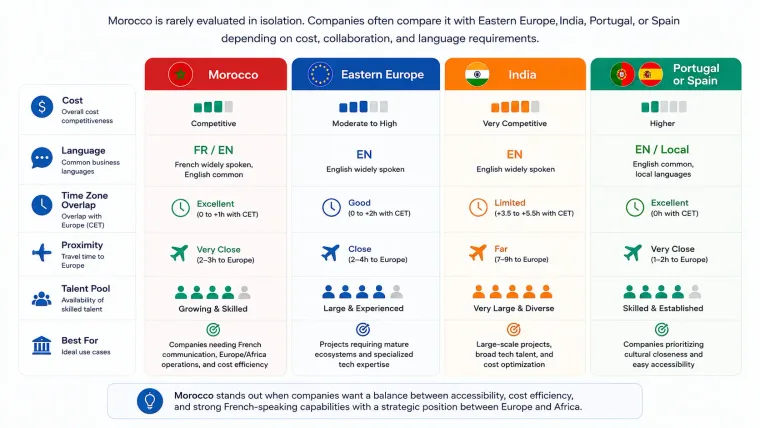
- working-hour overlap with Europe
- French and English communication where the team and engagement model are set up to support multilingual collaboration
- access to developers for product work, internal tools, integrations, and ongoing platform support
- flexibility to start with a smaller team and expand if delivery is working
Those benefits only matter if the hiring model matches the real work. A strong location fit does not fix unclear ownership, weak product direction, or rushed screening.
Hiring Models Available in Morocco
The right hiring model depends less on budget alone and more on how much definition, management, and continuity your project needs.
| Model | Best for | What you manage internally | Main watch-out |
|---|---|---|---|
| Direct hire | Building an internal long-term team in Morocco | Recruitment, onboarding, delivery management, retention | Slower setup if you need delivery capacity quickly |
| Staff augmentation | Adding capacity to an existing product or engineering team | Priorities, architecture, team integration, daily management | Weak internal leadership can turn extra developers into extra noise |
| Dedicated team | Ongoing roadmap execution with multiple roles and regular collaboration | Direction, governance, business priorities | Needs a clear communication rhythm and decision ownership |
| Fixed-scope project | Well-bounded work with stable requirements | Scope decisions, approvals, business feedback | Scope drift causes friction fast |
If you are still deciding how to evaluate external teams, read how to choose a software development partner before comparing providers only on resumes or price.
What Skills to Evaluate Beyond the CV
A CV can show tools and years of experience. It rarely shows how a developer behaves inside a real delivery environment.
Use this checklist when screening candidates or partner teams:
- Problem framing: can they clarify the problem before jumping into implementation?
- System thinking: do they understand dependencies, data flow, and downstream impact?
- Communication: can they explain trade-offs in plain language?
- Testing habits: do they talk about validation, edge cases, and release confidence?
- Documentation discipline: will decisions live in the team, not only in one person’s head?
- Ownership: do they raise risks early instead of waiting until work is blocked?
- Adaptability: can they work with evolving requirements without losing structure?
- Security awareness: do they treat access, environments, and data handling as delivery concerns from the start?
The goal is not to find developers who speak perfectly in interviews. The goal is to find people who reduce delivery risk once the real work starts.
How to Screen Developers Effectively
Good screening is less about trick questions and more about useful pressure testing.
What would you build first?
This shows whether the developer can prioritize and simplify. Strong answers usually connect the first delivery step to risk reduction, user value, or technical clarity.
What part of this project could become difficult later?
This reveals practical judgment. Strong candidates identify uncertainty around integrations, permissions, performance, unclear workflows, or handover risk instead of pretending everything is straightforward.
How do you validate that your solution works?
This separates people who only describe implementation from people who think about testing, observability, and release readiness.
What would you need from our team to work well?
This helps you detect maturity. Serious developers usually ask for priorities, access to the right stakeholders, decision speed, and clarity around ownership.
Can they explain trade-offs without hiding behind jargon?
If communication becomes vague the moment complexity appears, collaboration will likely become harder under delivery pressure too.
Communication, Timezone, and Delivery Fit
Use this simple decision framework before you hire.
- Choose Morocco more confidently when your stakeholders need regular overlap with European business hours and you want collaboration that feels close enough for weekly decisions.
- Lean toward staff augmentation when you already have clear product leadership, engineering standards, and an internal team that can direct day-to-day work.
- Lean toward a dedicated team when the roadmap is ongoing and you need continuity across development, QA, architecture, and delivery coordination.
- Be more cautious when your company expects the external team to discover priorities, make business decisions, and fill every internal gap without active collaboration.
If you want to compare engagement structures more directly, our software development services page shows how Systechra frames delivery support across software engineering, teams, and technical execution.
Contracts, IP, and Security Considerations
Hiring should not treat contractual and security topics as paperwork saved for the final week.
At minimum, clarify:
- who owns the code, documentation, and deliverables
- how repository, infrastructure, and environment access will be controlled
- whether subcontracting is allowed and how it is disclosed
- what documentation and handover are expected if the team changes
- how confidentiality and data handling expectations are reflected in the engagement
For regulated or sensitive projects, review final contractual and compliance requirements with qualified legal counsel. The operational point is simple: clear security and ownership terms make delivery easier, not harder.
Common Hiring Mistakes
The most expensive hiring mistakes usually happen before development begins.
- Choosing on rate before fit. Lower cost does not help if the team cannot support the delivery model you need.
- Hiring for tools only. A stack match matters, but communication, ownership, and judgment often matter more.
- Skipping real scenario questions. Generic interviews miss how developers think under ambiguity.
- Expecting developers to replace missing product decisions. External teams can help, but they cannot rescue absent ownership forever.
- Leaving security and IP questions until procurement closes. That creates friction precisely when trust needs to increase.
When Morocco Is the Right Fit
Morocco is often the right fit when most of these statements are true:
- you want timezone overlap with Europe without defaulting to a purely local hiring model
- your project needs more structure than a freelancer setup but not unnecessary enterprise overhead
- multilingual collaboration is useful for your stakeholders
- you care about steady execution and communication quality, not only speed of hiring
Morocco may be a weaker fit when the project requires a fully independent vendor to absorb every product and governance decision without real involvement from your side.
Ready to Shortlist the Right Team?
If you are already evaluating developers or delivery models in Morocco, contact us to discuss the team structure, screening approach, and collaboration model that fits your roadmap.
Frequently Asked Questions
What is the best way to hire software developers in Morocco?
The best approach depends on your roadmap. Short, well-scoped work may fit a project model, while evolving products often need staff augmentation or a dedicated team with stronger communication and delivery structure.
Should I hire individual developers or a software partner in Morocco?
Hire individual developers when you already have strong internal product and engineering leadership. Choose a software partner when you also need discovery, architecture guidance, QA, delivery governance, or long-term support.
What should I evaluate before hiring developers in Morocco?
Look beyond the CV. Review communication quality, problem-solving, testing habits, ownership, documentation discipline, security awareness, and how the team handles unclear requirements or changing priorities.
Is Morocco a good fit for long-term software delivery?
Morocco can be a strong fit for long-term delivery when your business values timezone overlap with Europe, multilingual communication, and a partner model that supports ongoing product decisions rather than task-by-task execution.
Keep reading