Offshore Software Development in Morocco: A Practical Guide for Companies Choosing the Right Partner
Learn why companies choose offshore software development in Morocco, how the delivery model works, what risks to manage, and how to evaluate the right partner for your project.
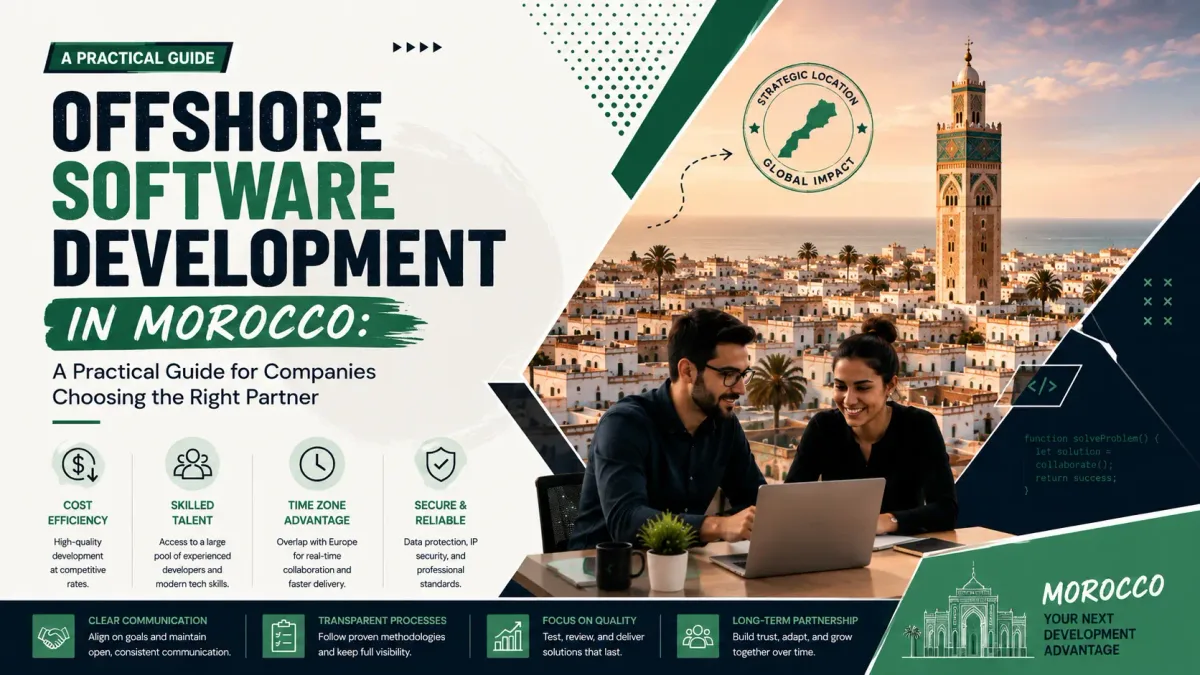
Companies looking at offshore software development in Morocco are usually trying to solve more than one problem at the same time. They want access to the right engineering capacity, a delivery model that fits their business, and a partner who can reduce risk rather than just add developers to a project.
Morocco can be a strong offshore destination for that. But the result depends less on geography alone and more on how the project is scoped, managed, communicated, and supported after launch.
This guide explains how offshore software development in Morocco works, why companies choose it, what delivery models are common, what risks to manage, and how to evaluate the right partner.
By the end, you will have a practical way to decide whether Morocco fits your offshore strategy and what to validate before you commit.
Key takeaway
Offshore software development in Morocco works best when the location advantage is paired with strong delivery governance, practical communication, and a partner who understands the business problem behind the build.
Why Companies Choose Offshore Software Development in Morocco
Morocco is attractive to many international teams because it combines several practical advantages in one market. In practice, those strengths still need to be validated against the specific partner, delivery model, and project complexity rather than assumed automatically:
For broader business context, the World Bank overview of Morocco is a useful external reference on the country’s economic position, investment environment, and development trajectory.
- access to software engineering talent
- timezone overlap with Europe and workable overlap with North America
- multilingual collaboration across English, French, and Arabic environments
- lower delivery cost than many onshore hiring models
- geographic proximity that can make travel and coordination easier than more distant offshore regions
For companies assessing Morocco as a business destination more generally, the Morocco market overview from Trade.gov adds useful context around international trade, commercial access, and market structure.
Those advantages matter most when the project is more than a simple task list. Companies often look at Morocco when they need an offshore team that can support product delivery, business software, integrations, internal tools, or long-term roadmap execution.
What Offshore Software Development in Morocco Actually Means
In practical terms, offshore software development in Morocco means working with a partner or team based in Morocco to design, build, extend, or maintain software for your business.
That can include:
- custom business applications
- SaaS products
- web platforms and portals
- API and system integrations
- internal workflow tools
- dedicated development team support
The important point is that offshore development is not just about finding lower-cost developers. It is about finding a delivery structure that gives your business the right balance of speed, cost, quality, and coordination.
The Core Rules for Making Offshore Delivery Work
Practical framework
What matters more than geography alone
Clarity before execution
The project should have clear priorities, workflows, constraints, and business outcomes before scaling delivery.
Governance over guesswork
A strong offshore setup needs clear ownership, decision paths, and regular visibility into progress and risk.
Communication that matches the project
Some projects work well asynchronously. Others need more live collaboration. The model should match the work.
Technical depth plus business understanding
The right offshore partner should connect architecture, integrations, and delivery choices back to business outcomes.
Why Morocco Can Be a Strong Offshore Destination
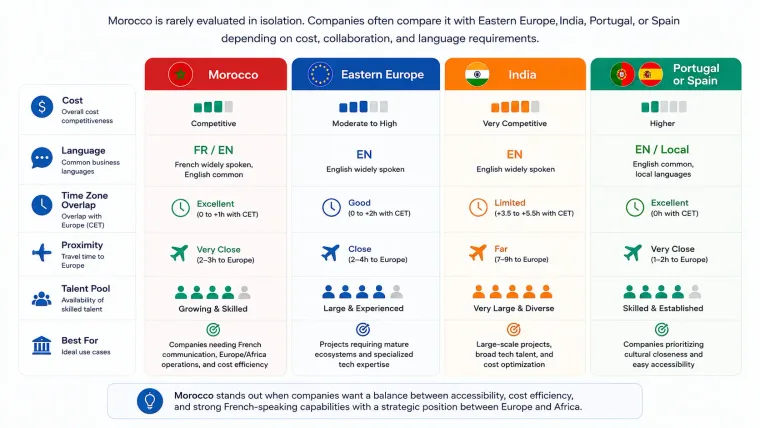
Morocco can make sense when your company wants a team that is easier to coordinate with than a very distant offshore market, while still benefiting from the economics and scalability of offshore delivery.
If you want a more market-specific view of that positioning, the U.S. International Trade Administration’s Morocco digital economy overview helps frame the country’s digital sector, infrastructure, and technology opportunity.
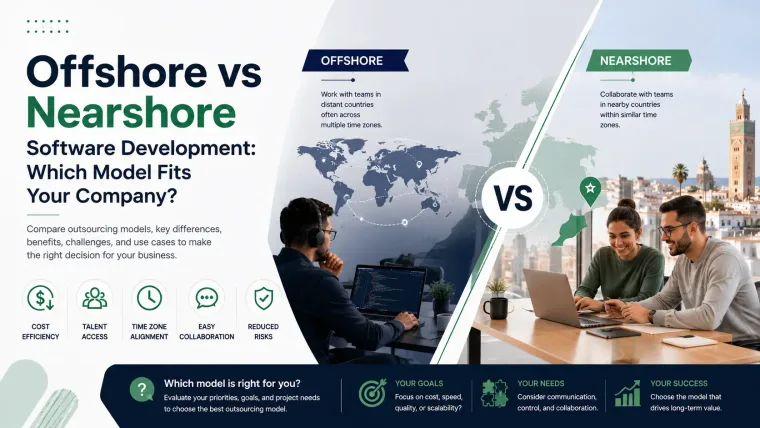
In many cases, Morocco is evaluated against broader outsourcing options rather than in isolation. If you are comparing regional delivery models directly, see offshore vs nearshore software development for a more focused comparison.
Delivery Models: Project, Dedicated Team, or Embedded Support
The best delivery model depends on how mature the scope is and how much ongoing collaboration the project needs.
| Model | Best for | Watch out for |
|---|---|---|
| Fixed-scope project | Well-defined initiatives with clear priorities and bounded outcomes | Scope changes can create friction if discovery was too shallow |
| Dedicated development team | Longer product roadmaps, evolving platforms, and multi-role delivery | Requires stronger internal decision-making and roadmap ownership |
| Embedded or hybrid support | Businesses that need flexible execution plus discovery, architecture, or ongoing improvements | Can become inefficient if roles and communication are unclear |
Risks to Manage Before You Commit
The biggest offshore risks are usually not caused by the country. They are caused by poor project structure.
Common risks include:
- unclear scope
- weak documentation
- unrealistic expectations about speed
- too many decisions happening informally
- poor testing and release discipline
- low visibility once development begins
How to Evaluate the Right Partner in Morocco
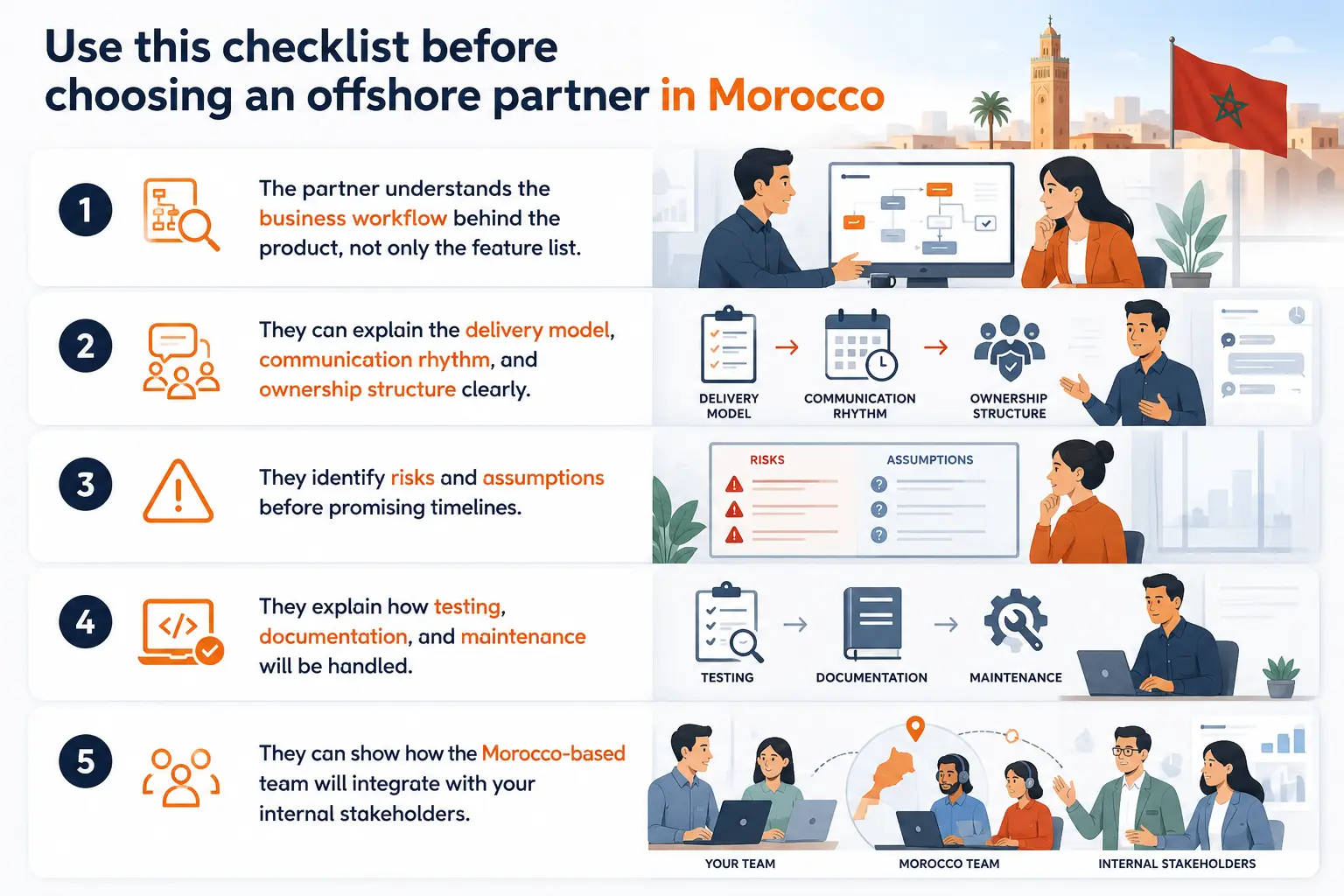
The strongest offshore relationship usually starts with better questions, not a faster quote.
Look for a partner who can explain:
- how they run discovery
- how they structure delivery and communication
- how they handle integrations and architecture trade-offs
- how they reduce long-term maintenance risk
- how they support quality control and release readiness
If you need a framework for evaluating those questions directly, start with how to choose a software development partner.
How This Connects to Systechra Services
Systechra supports companies that need practical offshore delivery help, from technical discovery and solution architecture to custom software, dedicated development teams, integrations, and longer-term product execution.
The goal is not just to offer offshore capacity from Morocco. The goal is to help companies build the right thing with the right structure and the right level of delivery confidence.
If you are exploring software engineering services and want to understand whether Morocco is the right offshore destination for your project, the safest next step is to talk through your project before you commit.
Frequently Asked Questions
Why do companies choose offshore software development in Morocco?
Companies choose Morocco for offshore software development because it offers a strong engineering talent base, good timezone overlap with Europe and workable overlap with North America, multilingual collaboration, and cost efficiency compared with many local hiring markets.
Is Morocco a good location for software outsourcing?
Morocco can be a strong outsourcing location when the partner has clear delivery structure, strong technical leadership, practical communication, and experience supporting international teams.
What delivery models are common for offshore software development in Morocco?
Common models include fixed-scope projects, dedicated development teams, and longer-term embedded delivery support depending on project clarity, roadmap length, and internal management needs.
What are the main risks of offshore software development?
The main risks are unclear scope, weak communication, poor governance, low documentation quality, and technical decisions that are not aligned with the business context.
How do I choose the right offshore software partner in Morocco?
Choose a partner by evaluating discovery quality, communication rhythm, technical depth, delivery governance, testing discipline, and how clearly they connect technical work to business goals.
Keep reading